
Leave Aristotle Alone.
Modern happiness culture loves to cite Aristotle. This essay argues it has him backwards.
When figures like Laurie Santos, Arthur Brooks, Martin Seligman, Sonja Lyubomirsky, and Gretchen Rubin invoke eudaimonia, they treat it as a richer feeling or a measurable, optimizable state. For Aristotle, in the Nicomachean Ethics, eudaimonia is not a feeling at all but the activity of a whole life lived well: objective rather than subjective, formed slowly through virtue and practical wisdom (phronesis), realized among others in the life of the polis, and always exposed to fortune.
The mistake is not only about Aristotle, but more in general about the Greek world that made his ethics intelligible. Read him in context, and the modern idea of a "happiness expert" with a protocol becomes a category error.
The full essay, including access to primary sources and reading suggestions, is available as a downloadable PDF.
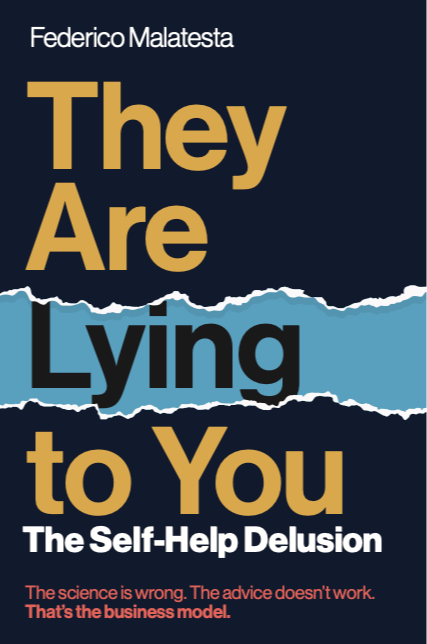
They Are Lying to You.
The Science is wrong.
The Advice doesn't work.
That's the business model.
Out Fall 2026
Leave Aristotle Alone.
Happiness, Eudaimonia and the erasure of context.
In a recent New York Times interview, the Yale psychologist Laurie Santos laid out “two main types of happiness according to ancient Greek philosophers,” hedonic and eudaimonic. Hedonic is “just a sense of good feeling,” she said, “good food, good sex.” Eudaimonic is “bigger,” “about living a good life,” the kind that comes “not just from your own pleasure but from other people and from building character.” And the Greeks, Aristotle included, “knew about both, but when push came to shove they were like, Go for the eudaimonic.”
Framed this way, eudaimonia becomes a richer grade of happiness, a better feeling drawn from better sources, one item on a 4th-century-BC Greek menu a sensible person would order over the other. Aristotle’s eudaimonia is none of that. Santos is not alone in reaching for Aristotle to dignify modern happiness discourse. She has plenty of company: Arthur Brooks, Martin Seligman, Sonja Lyubomirsky, and Gretchen Rubin all have a version of it. Each cites the Greek philosopher, but in every case he is cast in an anachronistic support role, lending ancient prestige to a set of assumptions that are thoroughly modern. They get Aristotle wrong because they get the Greek world wrong. They assume, most likely unconsciously, that the Greeks lived in a moral universe like ours, where the individual is the primary unit of focus, where values are chosen, and happiness is often understood as a private feeling each person defines for themselves. The Aristotelian world assumed almost none of this.
Introducing Eudaimonia.
Eudaimonia is built from eu, “well,” and daimōn, a divine or more-than-human power. In older Greek, to be eudaimōn was to be fortunate, well-favored, one’s life going well under a power larger than oneself. Aristotle keeps that sense of a whole life going well, but gives it a philosophical rather than devotional form. Eudaimonia becomes a term of ethical assessment, the objective shape of a life lived and acted well. It was never primarily about a flutter in the chest or butterflies in the stomach. To be eudaimōn, in plain terms, was to be living and acting well, both verbs of activity. For Aristotle eudaimonia is a way your life is, not a way you feel.
Happiness, in modern English, is instead subjective: it is for me, not for you, to say whether I have it. This is what Santos means in the first place. Its “cognitive part,” she says, describing not Aristotle but modern social science, is “being happy with your life… it feels good to be you because of how you think it’s going.” That is a self-rating, the verdict you deliver from the inside. Eudaimonia is a different kind of predicate, not finally settled by how things feel from within. And you can be wrong about it; a person, Aristotle says, can think he is happy when he is not. Feeling is not irrelevant for Aristotle, since the well-formed person takes pleasure in acting well, but it is not the criterion. And a good life that can be felt, rated, adjusted, and optimized is exactly what Aristotle is not describing.
A Full Life Amongst Others.
Aristotle’s famous function argument asks what the characteristic work of a human being is, and answers that the human good is “activity of soul in accordance with excellence … in a complete life. For a single swallow does not make spring.” Eudaimonia is often translated “flourishing,” which is fine as long as we don’t hear in it a private state of wellness you arrive at and then feel on your own. It is the active exercise of a life’s capacities at their highest pitch, expressible only at the scale of a whole life, and lived among others. For Aristotle the human being is “by nature a civic being,” whose capacities are developed and tested in the shared life of the polis. He is not first a private self who later joins the community by choice; he is formed within household, friendship, law, and common life, and is intelligible through those relations, as citizen, friend, household member, and participant, not as someone standing behind them. Eudaimonia happens in a world, in deeds that could be witnessed, in friendship, with others and through others. This is the opposite of “it feels good to be you because of how you think it’s going.”
The Role of Luck.
As importantly, eudaimonia was never wholly under your control. The Greek world was tragic before it was philosophical, and Aristotle never forgot it. A good life needs external goods, friends and resources and a measure of good fortune, and these can be destroyed by circumstances no method governs. Martha Nussbaum wrote a whole book on this exposure: the conviction, animating Greek ethics as a whole, that “the good human life is dependent on things that human beings do not control.” Focusing on “what you can control” is no guarantee of eudaimonia. The Greeks did not imagine that effort abolished contingency.
Virtues: Not on The Menu
The final nail in the coffin of the positive psychology/self-development version of Aristotle is the concept of virtue. Today we often take values to be personal, a set each of us assembles to taste, as if we were choosing muffins for breakfast: one blueberry, one vanilla raspberry, no double chocolate, too heavy this morning. In Aristotle’s world the virtues are not an à la carte. What counts as a virtue is not invented by private preference; it is grounded in an account of what human beings are, what situations human life must face, and what forms of action allow a life to go well. They are not mechanical rules either: each has to be enacted through judgment, in the particular case, by someone trained to see what the situation asks. There is no shopper, but there is no rulebook either.
No Protocols Apply. No Expert Required.
Finally, Aristotle is crystal clear that ethics, the study of how to live, is not the kind of subject that yields exact results; one should look for only as much precision as the matter allows. Living well is governed not by a science but by phronesis, practical wisdom, formed slowly through experience and character and never quite detachable from the person who has it. You can be an expert in optics, or carpentry, or medicine. Aristotle can picture teachers, legislators, mentors, the practically wise. What does not fit his framework is happiness as a portable expertise, detached from character, community, fortune, and the long apprenticeship of judgment, which is to say he cannot picture a “happiness expert” in anything like the modern, technocratic sense.
A New Story?
None of this means we must think like Greeks. Happiness is not a closed question, and no one is obliged to accept Aristotle’s answer. We can, by all means, build a new account for the world we actually live in: make room for the modern self, for therapy, for happiness as a feeling worth raising. That is what intellectual life is for. The one thing we cannot do is borrow Aristotle’s authority for it and make his words mean the opposite of what he wrote. Build the new account of happiness if you can. Just build it in your own name, and leave his to the book he actually authored.
The full essay, including access to primary sources and reading suggestions, is available as a downloadable PDF.
Download the full essay (PDF)Federico writes and speaks on leadership, identity formation, and the complexity of midlife transitions.
Reimagine what is next.
Transformational and Executive coaching for leaders navigating high-stakes transitions - when the old narrative no longer fits the facts.
Work with Federico