Numbers and Lies.
In popular self-help, a percentage you cannot defend is the genre's most reliable tell. This essay traces the claim that 95% of human behavior is subconscious, repeated across self-development books, courses, and protocols, from its academic origins to its industrial misuse.
The figure descends from a 1998 ego-depletion paper by Roy Baumeister, where it appears as a hypothetical defending conscious self-control; from a 1999 paper by John Bargh and Tanya Chartrand that inverted Baumeister's argument while citing him approvingly; and from a 2003 marketing book by Gerald Zaltman, where the number was extrapolated for consumer behavior, not measured. Both source research programs have since failed to replicate.
The borrowed number is the entry point to a broader critique of self-help's practices, drawn from my forthcoming book They Are Lying to You.
The full essay, including references and access to primary sources, is available as a downloadable PDF.
Download the full essay (PDF)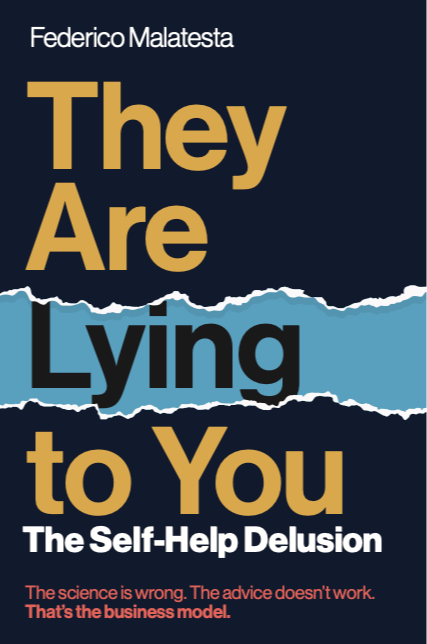
They Are Lying to You.
The Science is wrong.
The Advice doesn't work.
That's the business model.
Out Fall 2026
Number and Lies.
How Self-Development Cites What the Author Has Not Read
There comes a moment, somewhere in the middle of a self-development book or post, when the author reaches for statistics, delivered with absolute confidence. The numbers are presented as an established fact, and used to license the prescription that follows: reprogram the mind, master body language, follow this plan to achieve your goals. Then comes the final step: buy my trademarked method for only $49.99, original value $2,499.
This essay is about the fictional numbers that are neither traced nor checked, and why noticing it is the cheapest piece of intellectual hygiene available to anyone who has started to wonder whether the books and courses on the bedside table are doing what they claim. What follows is for the reader who is beginning to value footnotes.
Why a fictional number travels so well
What does a number actually do in popular psychology? It does work that no argument can do alone. It bypasses the question of whether the author has read the source literature. It signals that someone has counted, has done the initial homework, that the prescription rests on something firmer than opinion, that the room contains research even when the room contains no researcher. None of this is necessarily true. The numbers may be vaguely correct, with the same authority as “red sky at night, sailor's delight.” Sometimes accurate, never measured. In my experience, the number is doing marketing work, not measurement work. You are rarely in a position to tell which.
You, meanwhile, have neither the time nor the access to check. The original article sits behind a paywall, in a journal, with a methodology section that demands a graduate seminar to parse. So, the deference compounds. Each writer defers to the one before, and by the time the figure reaches the paperback or the protocol in your hands, it has passed through several sets of hands and, at best, a publisher's marketing department, and the qualifying clause has been deleted at every stop.
How 95% Became Neuroscience.
The percentage most often repeated in the contemporary self-development literature is the claim that ninety-five percent of human behavior is subconscious. The figure is offered as established neuroscience. It is the empirical scaffolding under a whole sub-industry selling the reprogramming of the mind.
I will gloss here on the fact that the subconscious, as described in popular self-development, does not exist; it is a category error and a tout court invention of the self-help industry designed to make you buy products you don't need. We'll come back to it in another context, but suffice to say that every time you find the word subconscious in an article, a book, a social media post, your brain should start sounding the "danger!" warning light. But for the time being, let's focus on the 95%. This figure is neither established psychology nor neuroscience, and it's the perfect example of how these numbers get recycled with no accountability.
In 1998 Roy F. Baumeister (an American social psychologist) and colleagues published an article in the Journal of Personality and Social Psychology with the title "Ego Depletion: Is the Active Self a Limited Resource?".[1] The paper argued that self-control draws on a single limited resource that gets depleted with use, similar to a muscle that tires. In this context the authors argued that even if they assumed a very high number, say 95%, to represent the percentage of automatic (unconscious) behaviors, the small conscious-control fraction would still be the steering wheel determining where the car goes. The key construction is hypothetical, a number they made up, not the result of a controlled experiment. The actual passage from the article reads: "Even if it were shown that 95% of behavior consisted of lawful, predictable responses to situational stimuli by automatic processes, psychology could not afford to ignore the remaining 5%." Someone must have said, "let's come up with a high number," to which someone else must have replied "yeah, let's make it 95%."
Then in 1999 social psychologists John A. Bargh and Tanya L. Chartrand published a second article, "The Unbearable Automaticity of Being," in American Psychologist.[2] As the title suggests, the article reached the opposite conclusion about what the proportion implies, i.e., that most of our behaviors are unconscious. And here is the sleight of hand. Bargh and Chartrand cited Baumeister's 95% number, but now this figure had been stripped of the hypothetical. They write: "Even as they were defending the importance of the conscious self for guiding behavior, Baumeister et al. (1998, p. 1252; also Baumeister & Sommer, 1997) concluded it plays a causal role only 5% or so of the time." But Baumeister never reached that conclusion. The 95% was a hypothetical chosen to dramatize his actual claim: that even granting the most extreme estimate of automaticity, the small conscious fraction is what determines outcomes. Bargh and Chartrand made two small edits. They changed "even if it were shown" into "concluded," and softened "5%" to "5% or so." Together those edits converted a thought experiment into a finding. And if this were not enough, it is worth noting that Baumeister, in his 1998 article, cited Bargh as a reference on automatic processes:
"recent work has shown that a great deal of human behavior is influenced by automatic or nonconscious processes (see Bargh, 1994, 1997)."
To summarize: Bargh wrote in the mid-1990s that human behavior is influenced by nonconscious processes. Baumeister quoted him but then argued that conscious processes, however small, carry the day. Then Bargh quoted Baumeister to argue that most human behavior is influenced by nonconscious processes. To compound the problem, both source research programs have had major replication problems in the 2010s, failing to replicate.[3] In the meantime, 95% became a fact. Yes, it is a mess. Now you must be thinking, "how can this have happened?" which was exactly my reaction when I started investigating these figures a few years back. But I can assure you that this is not the exception, especially in fields like psychology where the rigor around studies often leaves a lot to be desired, even with very reputable figures,[4] which explains why so much of the field has failed to replicate.
Interestingly, the 95% has a second, completely unrelated and equally flawed derivation, tracing to Gerald Zaltman's How Customers Think: Essential Insights into the Mind of the Market.[5] Zaltman's book is about consumer behavior, specifically how customers make purchasing decisions in marketing contexts, not about human cognition in general. Even within that narrow domain, the figure is not the result of a controlled experiment. Here Zaltman extrapolated the percentage from his interpretation of cognitive research; no experimental study has measured the conscious-versus-unconscious proportion of thought in any way that would yield this or any specific figure.
I have chosen this example because it is not obvious. On one hand, we know that a great deal of human behavior runs under the influence of the unconscious, even if we do not yet understand how, so the order of magnitude may not be wildly off. On the other hand, the figure should arouse natural suspicion: calculating it would require measuring the unconscious, which by definition cannot be directly accessed, because if it could be, it would not be unconscious. The self-development industry uses it anyway, to license the sale of products designed to rewire something that cannot be identified and located. Other numbers in the same literature are worse, and easier to debunk on inspection. The claim that two percent of people "reach their full potential" is one of them. The measurement that would yield such a figure does not exist, and never has.
Simplification is not the problem. Direction is.
It's easy to realize at this point how anyone who has the time to follow the citation through this rabbit hole to its origin discovers that the number does not exist in the form in which it is presented. Anyone who does not follow it has no way of knowing.
There is a defensible counter-argument: every popular book simplifies, and demanding academic precision from a self-development paperback is a category error. This is fair, up to a point. Simplification is not the problem. The problem is the direction of the simplification. When the simplified version reverses the argument of the source, when a careful defense of conscious self-control becomes a slogan for its irrelevance, the simplification has stopped being a simplification and become a misuse. Readers are not asking for footnotes; they are asking, reasonably, that the headline roughly match the article.
Once you have started counting footnotes, you cannot un-count them. The discipline is small and unglamorous. When a book offers you a percentage, ask where it comes from. If the author does not say, that already tells you something. When the source is named, follow the citation one step, if it is not convincing, maybe two or three. A figure that cannot survive a couple of steps of inspection is not evidence; it is a decoration created because the argument has no legs to stand on. Think of this as the basic courtesy you extend to your own attention. Most of what the industry sells does not survive it.
This is one of the tricks the self-help industry uses to sell you things you don't need. There are many more. The book traces them across psychology, psychoanalysis, philosophy and neuroscience, and shows you how to recognize them on your own.
They Are Lying to You
out this Fall
---
[2] John A. Bargh and Tanya L. Chartrand, "The Unbearable Automaticity of Being," American Psychologist 54, no. 7 (1999): 462–479.
[3] The ego-depletion effect failed to replicate in a large preregistered multi-lab study, see Martin S. Hagger et al., "A Multilab Preregistered Replication of the Ego-Depletion Effect," Perspectives on Psychological Science 11, no. 4, 2016: 546–573. Bargh "elderly priming" study failed to replicate in Stéphane Doyen et al., "Behavioral Priming: It's All in the Mind, but Whose Mind?" PLOS ONE 7, no. 1 (2012).
[4] Baumeister worked at Florida State University as the Francis Eppes Eminent Scholar and head of the social psychology graduate program, Bargh formed the Automaticity in Cognition, Motivation, and Evaluation (ACME) Laboratory at Yale University, Chartrand is the Roy J. Bostock Professor at Duke Business School
[5] Gerald Zaltman, How Customers Think: Essential Insights into the Mind of the Market (Boston: Harvard Business School Press, 2003).
The full essay, including references and access to primary sources, is available as a downloadable PDF.
Download the full essay (PDF)Federico writes and speaks on leadership, identity formation, and the complexity of midlife transitions.
Reimagine what is next.
Transformational and Executive coaching for leaders navigating high-stakes transitions - when the old narrative no longer fits the facts.
Work with Federico